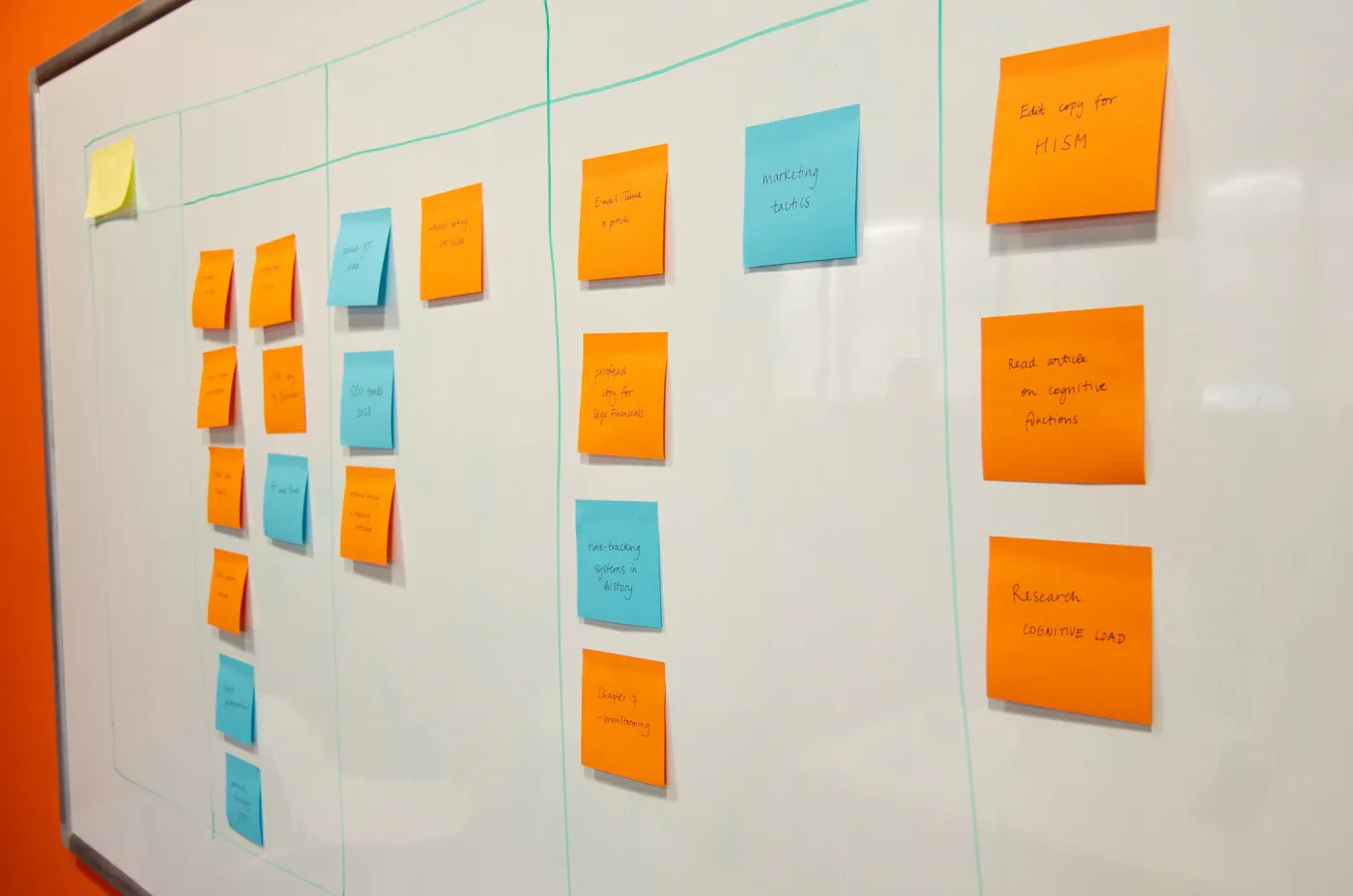
Manage multiple AI projects with a separate current-state brief for each one, a simple project register, and clear references to the latest files. Keep shared preferences in one place, but keep project-specific audiences, decisions, and approvals attached to the relevant work.
The aim is to make switching projects a short verification step. You should not have to reconstruct a week of conversation every time you return.
Give every project a distinct identity
Use a descriptive name and a stable identifier. “Website” is easy to confuse with another website; “Agency website — launch copy” identifies the task more clearly.
Define the outcome and the authoritative artifact. If a project has several workstreams, keep their relationship explicit: copy, design, and implementation may share a brief while maintaining different current files.
Do not create a new project for every small request. Split work when it has a different objective, audience, owner, access boundary, or source of truth.
Keep a small project register
| Field | Example purpose |
|---|---|
| Project | Distinguishes the work |
| Objective | Reminds you what completion means |
| Current artifact | Points to the latest real output |
| Status | Active, waiting, paused, or complete |
| Next action | Makes re-entry concrete |
| Handoff | Links to the current project brief |
| Last reviewed | Shows when the record was checked |
The register is an index, not a second copy of every project. Keep detailed decisions in the individual handoff.
Examples in a register should be your actual records. Do not let an automatically generated status imply progress that has not occurred.
Separate shared preferences from project constraints
A general preference such as concise language may apply broadly. A client’s approved tone, legal restrictions, technical stack, or publication permission belongs to that project.
When starting work, state which project is active and what task you want completed. If a requirement changes, update the relevant brief rather than relying on the assistant to infer that the change applies only to one project.
Use the handoff template to keep decisions and constraints distinct.
Use a re-entry prompt
Resume [project name].
Use [handoff] and [current artifact/version].

Confirm the current objective, any missing material,
and the next action. Keep this separate from my other
projects.

Then complete:
[bounded task and expected output]

Do not reuse assumptions from another project unless
I explicitly identify them as shared.
The prompt does not guarantee technical isolation by itself. Use the provider’s actual workspace and sharing controls where separation matters.
Store the work outside the transcript
Keep documents, code, research sources, and exported files where you can retrieve them. A chat message describing an output is not the output.
Use consistent version naming or the existing version-control system. Avoid files called “final-final-new” when a date or version number can identify the current artifact more clearly.
For a new conversation, transfer the current handoff and necessary files using the continuation workflow.
Prevent context from crossing the wrong boundary
Before sharing a project or switching providers, review the information included. Remove unrelated client details and unnecessary personal data. Check file permissions rather than assuming a link is safe because it is convenient.
If one project references another, describe the specific shared dependency. For example, two product pages may use the same approved company description while retaining different pricing and audiences.
Do not copy a whole project brief merely to reuse one paragraph.
Review the register at a regular rhythm
For each active project, check whether the next action is still correct, whether the current artifact exists, and whether the handoff reflects the latest decision. Mark waiting items with the person or information needed.
Archive completed projects with their final artifact and any ongoing obligations. “Complete” should not mean the chat went quiet.
The long-conversation context guide explains how checkpoints keep these records current during work.
Keep the system lighter than the work
Start with a folder, a register, and one short handoff per active project. Add tooling only when a repeated problem justifies it.
The small-business software selection guide offers a useful test: can the tool help you complete a real recurring task with less confusion? The same standard applies to your AI project system.
If you want each project to have a reusable objective, decision record, and next-step handoff, explore ThreadKeep.